What people mean by an AI SDR
"AI SDR" covers a wide range of software. At one end are assistants that research accounts, find contacts and draft messages for a rep to review. At the other end are autonomous agents that choose prospects, write and send sequences and reply to responses with little human involvement. Products such as 11x and Artisan market themselves toward the autonomous end; many prospecting tools sit closer to the assistant end. Capabilities change quickly, so check each vendor's current documentation rather than relying on a category label.
The distinction matters because the risks are different. An assistant that drafts a weak email costs a rep a minute of editing. An agent that sends a weak email to a thousand prospects costs you reputation with a thousand buyers and possibly your sending domain.
What a human SDR actually does
The SDR role looks simple from outside: find prospects, contact them, book meetings. In practice a working day mixes several distinct kinds of work.
- Choosing which accounts to work, inside a territory or segment.
- Researching each account and the people in it.
- Finding contact details and checking that they are current.
- Writing first messages and follow-ups.
- Making calls and holding live conversations.
- Handling replies, objections and referrals to the right person.
- Qualifying interest and handing over to an account executive with context.
- Feeding what they hear back to marketing, product and leadership.
Some of these tasks are repetitive and rule-based. Others depend on reading a person, a moment or a market. That split is the heart of the comparison.
AI SDR vs human SDR task by task
Building a list that matches the ICP
- AI SDR
- Strong, consistent across thousands of accounts
- Human SDR
- Slower, quality varies by rep
Researching public pages for signals
- AI SDR
- Strong, reads many pages quickly and can cite sources
- Human SDR
- Good, but limited by time per account
Finding and verifying contact details
- AI SDR
- Strong with good data sources
- Human SDR
- Slow and tedious by hand
Drafting a first message from a signal
- AI SDR
- Good, needs a clear tone and review
- Human SDR
- Good, slower, depends on the rep's skill
Deciding whether a signal really matters
- AI SDR
- Fair, can misread context
- Human SDR
- Strong when the rep knows the market
Live phone conversations
- AI SDR
- Weak for most B2B buyers
- Human SDR
- Strong
Handling objections and nuance in replies
- AI SDR
- Fair for simple replies, weak on complex ones
- Human SDR
- Strong
Working several people in one account
- AI SDR
- Fair
- Human SDR
- Strong, builds relationships over time
Feedback to product and marketing
- AI SDR
- Limited to patterns in data
- Human SDR
- Strong, rich qualitative insight
Working outside office hours
- AI SDR
- Strong
- Human SDR
- Limited
Where an AI SDR wins
Research at scale
Reading a homepage, careers page, press page and blog for every account in a territory is exactly the kind of work software does well. It does not get tired at account forty and does not skip the careers page on a Friday afternoon. When each finding comes with a link to its source, the rep can trust it and verify it quickly.
Consistency against the profile
Two human reps given the same ideal customer profile will still grade borderline accounts differently. Software applies the same rules every time, which makes reporting cleaner and gives managers one shared definition of a good-fit account.
Speed on signals
A new executive, a funding round or a hiring push is most useful in the first days. Software that watches accounts and raises an alert when something changes reaches those moments faster than a rep checking pages by hand. Our guide to sales trigger events explains why the first week matters.
Coverage of the long tail
Every territory has accounts that are a reasonable fit but never get attention because reps focus on the obvious names. Software can keep watching the long tail and surface an account only when it shows a reason to reach out.
Where a human SDR wins
Judgment and context
A rep who knows the market can tell when a signal is misleading: a job posting that has been open for a year, a funding round that is really a bridge, a new executive who came from a competitor and will bring their own tools. Software can flag these things; a person is still better at weighing them.
Live conversations
Many B2B deals still turn on a phone call or a video conversation where the buyer asks an unexpected question. Listening, adjusting and earning the next step in real time remains a human skill.
Relationships across the buying group
Most purchases involve several people with different concerns. A rep who builds trust with a champion, learns the internal politics and brings the right colleague in at the right moment does something no sequence replicates.
Handling objections and odd replies
"We just signed with someone else, but talk to me in spring" or "not me, try our new ops lead" are replies with real value. A person reads them correctly and acts on them. Automated replies often misread the intent or answer too eagerly.
Learning that feeds the business
SDRs hear the market every day. The objections, the competitor names, the language buyers use: all of it feeds positioning, product and the profile itself. That loop works best when a person is in the conversations.
Risks of fully autonomous outbound
Autonomous sending can work for some teams, but go in with clear eyes about the risks.
- Brand voice. A message that sounds generic or slightly off is sent in your name to people you may want to sell to for years.
- Factual errors. If the system misreads a page and mentions something that is not true, the reader notices immediately.
- Sending reputation. High volumes of low-relevance email hurt deliverability for the whole domain, including your account executives' replies.
- Compliance. Outreach rules differ by region and channel. Someone on your team still owns the decision to contact each person.
- Lost learning. If no person reads the replies, the team stops hearing what the market says.
None of these risks is unique to software; a careless human team can create the same problems. Volume simply makes them bigger and faster.
The hybrid model most teams can use
The practical answer for most B2B teams is to split the work by strength. Software scouts, grades and drafts. People decide, send, talk and build relationships.
Define and update the ICP
- Owner
- Sales leader with input from reps
- Output
- One written profile with disqualifiers
Build the weekly list
- Owner
- AI
- Output
- Ranked accounts with fit grades and reasons
Research signals
- Owner
- AI
- Output
- Signals with source links and quoted evidence
Find contacts
- Owner
- AI
- Output
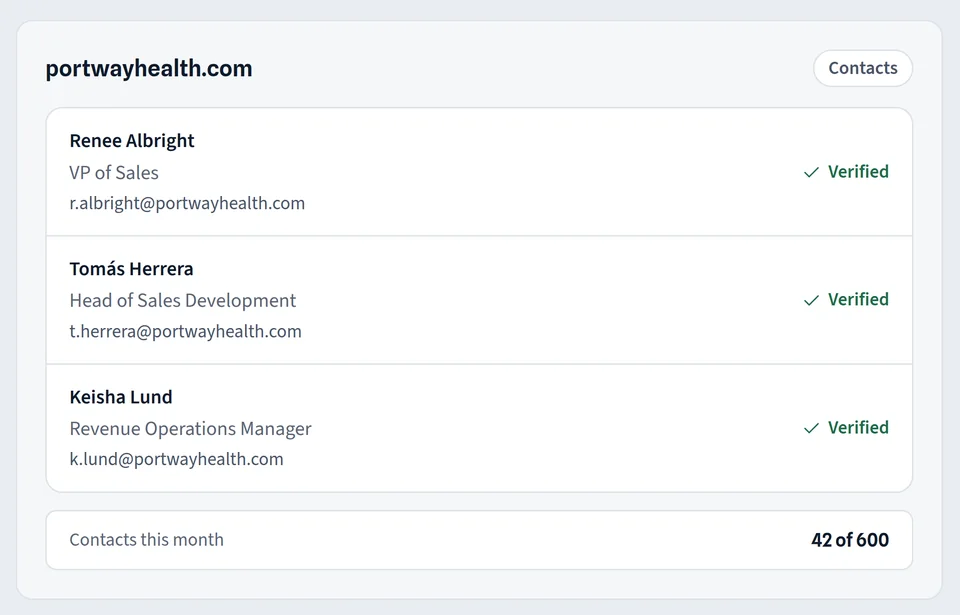
- Verified work emails and direct lines for the right roles
Draft first messages
- Owner
- AI
- Output
- A first email and a LinkedIn note per account
Review and edit
- Owner
- Rep
- Output
- Messages the rep is willing to sign
Send and call
- Owner
- Rep
- Output
- First touches and live conversations
Handle replies and qualify
- Owner
- Rep
- Output
- Meetings with context for the account executive
Review what worked
- Owner
- Rep and leader
- Output
- Changes to the profile and the angles
In this model the rep's day shifts from research toward conversations. For example, if a rep spends eight hours a week on account research, that is a fifth of the week that can go back to calls, follow-ups and working several people in each account. That is illustrative arithmetic, not a promise; measure your own team's research time before and after.
How to decide what is right for your team
- Founder doing founder-led sales with no SDRs: an assistant that researches and drafts gives you much of what a first sales hire would do, while you keep the conversations.
- Small SDR team: keep the reps, give them software for research and drafting and raise the number of well-researched accounts each rep can work.
- Larger sales organization: standardize the profile and grading in software, keep humans on every send and every reply, and use alerts so reps react to signals quickly.
- Agencies running outbound for clients: separate workspaces per client and clear review steps protect each client's brand.
Whatever you choose, start with a short trial on a defined segment, compare the reply quality against your current process and only then widen it.
Questions to ask any AI SDR vendor
- Where does the data come from, and can I see the source of every claim the system makes about an account?
- Does a person approve messages before they are sent, or does the system send on its own?
- How are contact details verified before export?
- How does the system avoid duplicates when syncing to my CRM?
- How are opt-out requests handled, and how does the vendor approach GDPR and CCPA?
- What does pricing depend on: seats, accounts, contacts, credits or messages sent?
Where ProspectScouter fits between the two
ProspectScouter sits on the assistant side of the AI SDR range on purpose. It builds your profile with the ICP builder, returns a ranked weekly scouting board, writes a scouting report for each account with a fit grade, buying signals linked to their public sources, roles to contact and a suggested angle, and drafts a first email and a LinkedIn note in your tone. The contact finder adds verified work emails and direct lines. Your reps review, edit and send. The AI SDR page explains the approach in more detail and the outreach openers page shows how drafts are written from signals.
For sales leaders, accounts sync to HubSpot, Pipedrive or Salesforce after deduplication, and the security page covers data sources, opt-out handling, GDPR and CCPA. Plans start at $49 per month for one seat, with yearly billing at half the monthly price; see pricing for seats and monthly limits.