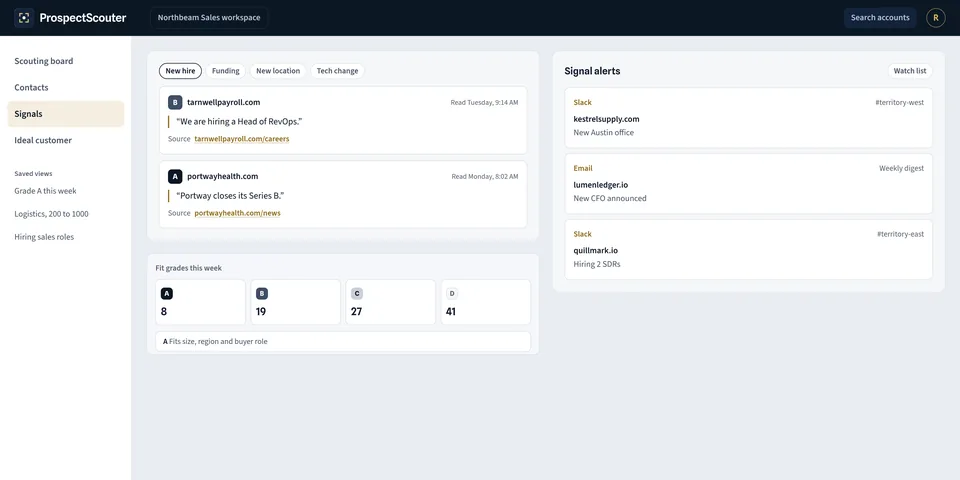
What a buying signal is
A buying signal is an observable change or action that raises the chance an account has a problem you solve and a reason to deal with it soon. Some teams call it a selling signal, because it is the moment a seller should act. The two terms describe the same thing from different sides of the table.
Signals come in two broad kinds. Company signals are changes at the account itself, such as a new executive, a funding round or a wave of job postings. Engagement signals are actions people at the account take toward you or your category, such as reading your pricing page or asking peers for recommendations. Company signals are usually public and easy to verify. Engagement signals are often stronger, but you see fewer of them.
Fit, intent and timing are different things
Fit says the account matches your ideal customer profile. Intent says someone there is looking into your category. Timing says something changed that makes action likely soon. A buying signal usually speaks to intent or timing. It does not replace fit. A strong signal at an account outside your profile is still a poor use of a rep's day.
Company change signals you can verify on public pages
The first nine signals are changes at the company. You can find all of them on careers pages, press pages, leadership pages, blogs and public announcements, which means you can link to the source when you mention them.
1. Hiring for a role you help
A job posting for the team that uses your product is the clearest public signal there is. The company has budget for that function, a manager who owns the problem and often a written description of what the new hire will fix. For example, a company that sells call coaching software should pay attention to an account posting three SDR roles at once. Read the posting itself: phrases such as "build the process from scratch" or "replace manual reporting" are worth quoting.
2. New funding
A new funding round usually comes with a plan to grow headcount, enter new markets or professionalize operations. The signal is strong for products that help a team scale, weaker for products that only cut cost. Funding also brings a flood of vendor emails, so the message has to connect the round to a specific plan the company has stated, not just offer congratulations.
3. New executive
A new VP or C-level leader often reviews the tools and vendors in their area during the first months in the role. They have a mandate to change things and want early wins. The window is real but not endless, so reach out while the person is still forming a plan. Their public introduction post or interview often says what they were hired to do.
4. New location or office
A new office, warehouse, store or country creates practical work: hiring locally, payroll, compliance, logistics, IT setup and local marketing. If your product helps with any of that, a location announcement is a timely reason to write. Job postings listing a new city are often the first public trace.
5. Technology change
When an account adopts, replaces or drops a tool near yours, something is in motion. A company moving to a new CRM may need data cleanup, integrations or training. A company removing a competitor may be open to an alternative. Job postings that list required tools and public integration pages are practical places to spot it.
6. New product launch
A launch creates new demand for sales, marketing, support and operations around the new offer. It also tells you what leadership cares about right now. If the launch targets a market you know well, you can be useful in a way generic vendors cannot.
7. Entering a new market or segment
Moving upmarket, adding a new vertical or starting to sell internationally changes what a team needs. Look for new pages on the website, new case material aimed at a different buyer or job postings for roles such as enterprise account executive or partner manager.
8. Merger or acquisition
Two companies becoming one creates overlapping tools, duplicate processes and a long list of integration work. It can also freeze spending for a while. Treat it as a medium signal: helpful for products that consolidate or migrate, less so for net new spend.
9. Rapid headcount growth
When the number of open roles grows quickly across several teams, the company is under strain in many places at once. Processes that worked at a smaller size start to break. Growth on its own is a weaker signal than hiring for your specific function, but it supports a stack of other signals.
Engagement and intent signals that show active interest
The next five signals come from people taking action. Some you see in your own systems, some are public.
10. Repeat visits to your pricing or integration pages
If your website analytics can match a visit to a company, repeat visits to pricing, security or integration pages are a strong sign that someone is comparing options. Handle it with care. Never start the email with "I saw you on our pricing page". Use it to prioritize the account and lead with something useful.
11. A former champion joins a new company
A person who bought or used your product before already knows its value. When they move to a new company that fits your profile, they are one of the warmest contacts you will ever have. Keep a list of past champions and check it regularly.
12. Engagement with your content or events
Downloading a guide, attending a webinar or commenting on your posts shows interest in the topic, not necessarily in buying. It becomes meaningful when several people from the same account engage, or when it lines up with a company signal.
13. Public questions about the problem
People ask peers for advice in public: in community threads, on professional networks and in industry groups. A leader asking "what are teams using for X" is close to a request for proposals. Respond to the question with help first, and reach out separately only when it fits.
14. Stated priorities from leadership
Leaders say what matters in shareholder letters, earnings calls, conference talks, podcast interviews and company blog posts. When a stated priority matches the outcome your product delivers, you have a reason to write and a quote to anchor it to. This signal lasts longer than most, often for the full planning year.
Rank buying signals by strength and shelf life
Not every signal deserves the same response. The table below is a starting point; adjust it to what you see in your own deals.
Hiring for a role you help
- Strength
- High
- How long it stays useful
- While the posting is open, plus a few weeks
New executive in your buyer's area
- Strength
- High
- How long it stays useful
- The first months in the role
Former champion joins a fitting company
- Strength
- High
- How long it stays useful
- The first months in the role
Repeat visits to pricing or integrations
- Strength
- High
- How long it stays useful
- Days
New funding
- Strength
- Medium to high
- How long it stays useful
- A few months
Technology change near your product
- Strength
- Medium to high
- How long it stays useful
- Until the project settles
Public question about the problem
- Strength
- Medium to high
- How long it stays useful
- Days to a couple of weeks
Stated leadership priority
- Strength
- Medium
- How long it stays useful
- The planning year
New location or office
- Strength
- Medium
- How long it stays useful
- Until the location is running
New product launch
- Strength
- Medium
- How long it stays useful
- A few months
Entering a new market
- Strength
- Medium
- How long it stays useful
- A few months
Merger or acquisition
- Strength
- Medium
- How long it stays useful
- Varies, integration can take long
Rapid headcount growth
- Strength
- Low to medium
- How long it stays useful
- While growth continues
Content or event engagement
- Strength
- Low on its own
- How long it stays useful
- Days
Stack signals instead of chasing a single one
One signal is a hint. Two or three pointing the same way are a reason. For example, an account that matches your profile, just raised a round and is hiring a head of the team you serve has three overlapping reasons to look at your category this quarter. That account deserves a researched, personal message. An account with only a burst of content downloads deserves a lighter touch.
A simple way to make stacking practical is to combine it with a fit grade. Grade the account against your profile first, then let signals move it up the list. This keeps reps from chasing loud signals at accounts that would never buy. The account scoring page shows how ProspectScouter combines fit and signals into an A to D grade with the reasons written out.
Write the first message from the buying signal
A signal is only useful if the message uses it well. The pattern that works is short: name the change, connect it to a likely problem, offer one specific idea and ask a light question.
For example, for an account hiring three customer success managers at once, a first email could read like this.
- Subject line: three new CSM roles
- Opening line: Saw you are hiring three customer success managers, which usually means onboarding volume is about to grow faster than the team.
- Value line: Teams in that spot often struggle most with the first two weeks of each new account, when every handoff is still manual.
- Ask: Worth a short comparison of how others structure that handoff?
Notice what the message avoids. It does not list your features, it does not pretend to know their internal plans and it does not claim results. It shows that you looked, offers a relevant thought and leaves room for a reply. Our guide to sales trigger events covers the full week-by-week sequence after the first message.
Mistakes that waste good signals
- Waiting too long. A signal from two months ago reads as stale, and the account has likely heard from many vendors already.
- Sounding like surveillance. Mention public facts naturally. Never reveal tracking of individual behavior.
- Treating every signal as urgent. A rep who chases every alert has no time for the accounts that matter.
- Ignoring fit. A strong signal at a poor-fit account is still a poor-fit account.
- Copying the press release back to them. They know they raised money. Tell them something they may not have considered.
- Not citing the source internally. If a rep cannot show where a signal came from, a manager cannot check it and the next rep cannot reuse it.
How ProspectScouter finds buying signals for you
ProspectScouter reads public company pages for every account on your scouting board: homepage, careers and jobs pages, about pages, news and blog posts, plus public filings and announcements. It looks for the signals in this guide, including hiring for a role you help, new funding, a new executive, a new location, a technology change and a new product launch. Each signal in the scouting report comes with a link to its public source and a quoted snippet, so a rep can verify it in one click before mentioning it.
From the signal, ProspectScouter suggests an angle and writes a first email and a LinkedIn note in your tone, which you can read more about on the outreach openers page. On Growth and above, you can watch accounts and get an email or Slack alert when one shows a new signal. For a broader look at how this fits next to other tools, see our page on sales intelligence.